.png)
Here is the secret to designing a really good online course
- Zoe Sims
- May 7, 2025
- 5 min read


Let's say it's Monday morning (ugh). OK scrap that. It's Friday morning (yay!). Picture me at work (more specifically, sitting on my sofa still in my PJs, about to log into my company-issued Dell). In my inbox I find an urgent assignment from my manager:
Zoe. I need you to design an online course about home organisation - STAT.
My manager doesn't actually speak like a doctor in a cheesy hospital-based soap opera but let's go with it.
...STAT.
Before I start researching home organisation tips, before I check out existing courses about home organisation for inspiration, before I start sketching out module titles, before I do ANYTHING, I must make a cup of tea and then ask my manager one vital question.
Who is this course for?
The answer to this question will impact every. single. thing. about the course I'm about to design. Let me explain.
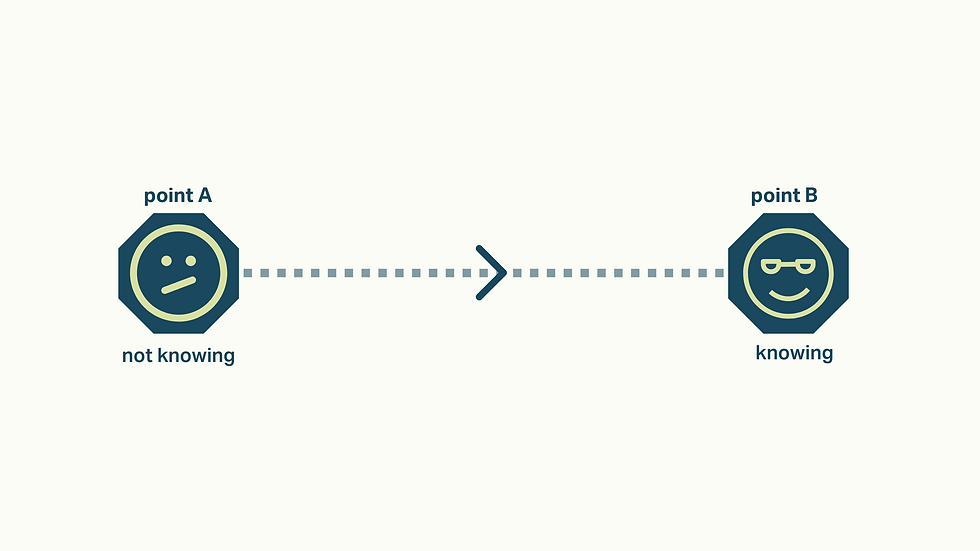
Designing an online course boils down to one task, and that is to take a bunch of people on a journey to a destination. Designing a course is like being a hiking guide. You are leading a group of people from point A (the start line, or the point of not knowing anything about the topic), to point B (the finish line, the point of knowing just the right amount about the topic).
Understanding your learners
What happens if you, the hiking guide, map out a route before you even know who it is you're taking on this expedition?
What if you map out a route through dense jungle and up steep rocky mountains and over raging rivers only to find that you're leading a group of elderly chess players who fancied a stroll?
What if you map out an easy, flat trail over paved paths with regular ice cream stops, only to find that you're leading a group of intrepid mountaineers who recently scaled Everest?
My point is: not all courses are going to be equal.
Some learners will want the easiest, breeziest, fastest, funnest overview, a whistle-stop tour of the basics. Other learners will want to delve into the deepest, darkest, dustiest corners of the topic. They'll want to come out the other end knowing everything anyone has ever known about how to fold pants.
Our job as course designers is to find out who our learners are and what they want to achieve so that we can create an experience that doesn't overwhelm or bore them.
In my online course Develop your course into an actionable idea I explain exactly how you can do this using my learner analysis template - and you'll also discover how to apply this information to your course plan.
Once you know who your learners are and what they want to achieve, you'll have a better idea of what to include in your course and how to present the information in a way that grips them by the lapels and shouts: YOU'RE LEARNING SOMETHING AWESOME.
Breaking content down into modules and topics
The next stage, once you know what it is you're going to include in your course, is to break your content down into modules and topics.
A module (sometimes called a lesson) is a smaller, self-contained unit of a larger course. Each module covers a specific topic or set of related topics, and together, they form the complete course, helpfully signposting the learner's journey from not knowing, to knowing.
It's much easier to process information in small, well-labelled chunks than in one big, never-ending stream, don't you think?

There are all kinds of ways to guide people to their destination (the point of 'knowing), but the best route will provide just the right level of:
Challenge (so that learners can level-up without feeling overwhelmed).
Support (so that learners aren't left to struggle alone).
Reward (so that learners get a kick from what they're doing, to make the effort worth it).
Different people require different levels of each, so try to anticipate what motivates your learners so that you can tailor your content to them.

Getting the motivation levels right
In order to provide the right level of challenge, support and reward in your learning journey, you have to understand how your learners are approaching the course - what sort of things are they thinking and feeling?
Are they beginner, intermediate, or advanced in your subject? How much time do they have? How motivated are they? Where does that motivation come from - inside them, or from an external source?
We all have a tendency to assume everyone else thinks the same way we do, but this puts us at risk of designing a course we'd love to take ourselves, but which might not be entirely suitable for other learners.
In my course, Design a learner-friendly course structure, we'll create an empathy map together using my template so that you can get the levels spot-on.
Creating an engaging experience
Unlike teachers in a classroom, you can't be with your online students in real-time to notice who needs a little extra help, or which topics have the class on the edge of their seats and which are sending them to sleep. You don't get to see their reactions, or hear their questions. This means that you'll need to build motivation, support and reward into your learning journey.
There are three ways you can do this:
Content
Feedback
Community
Course content

Your content should:
be varied in format (video, graphics, interactive etc.) to keep things interesting without seeming chaotic - it's a delicate balance!
tell stories (whether anecdotes from your own expert experience, or through characters in a scenario) to bring topics to life
be just the right length
offer rewards a incentives
Feedback

Feedback is like a GPS for your learning journey. It keeps learners on track, helps them avoid potholes and points the way to success. This might look like:
Commenting: leave comments directly on learners' assignments, quizzes, or discussion posts.
Grading: assign grades to assignments and provide detailed feedback on the learner's performance.
Rubrics: rubrics can be used to outline the expectations for assignments and provide a structured way to give feedback.
Annotations: some platforms allow you to annotate learners' work, highlighting areas for improvement or providing additional explanations.
Messaging: use messaging features to communicate directly with learners and provide personalised feedback.
Community

Social learning can be a powerful tool for online learners. By interacting with you and their peers, learners can gain new perspectives, deepen their understanding of the course material, and enjoy a sense of community.
Many course platforms offer social functionality, but you can also set up groups on other social media platforms, or even host video chats and in-person events.
In summary
The secret to designing a really good online course is to design a learning journey tailored to the people taking your course. What do they want? How do they want it? Remember: you are the hiking guide. They're trusting you not to overwhelm or bore them. Use your creativity to get them up the tricky, steep bits. Soon, you'll reach the summit. You'll get to see their beaming faces. You'll have the honour of effectively teaching them something new!
What's next?
Need help planning, developing and launching your online course? I've created a series of interactive courses (one for each step of the way) to share my professional tips and give you a guiding hand.
Comments